
A guest sends a WhatsApp message asking for an early check-in while the front desk is handling a new arrival and housekeeping is preparing several rooms. Someone needs to check the reservation, confirm room availability, coordinate with the housekeeping team and send the guest an update.
Each step is manageable on its own. The difficulty comes from coordinating them while other hotel operations continue.
An Agentic AI Operating System for Hotels can help manage these connected workflows by understanding requests, checking available information, initiating permitted actions and tracking progress across connected systems. With the right integrations and controls, hotels can automate repetitive coordination while keeping employees involved in decisions that require human judgment.
Here are 10 hotel processes where agentic AI can support daily operations, improve task visibility and reduce manual follow-ups.
What Is an Agentic AI Operating System for Hotels?
An Agentic AI Operating System for Hotels is an operational intelligence layer that uses AI agents to understand business requests, determine appropriate next steps and execute multi-step workflows within defined permissions.
Traditional automation typically follows predetermined rules. A conventional chatbot answers questions or provides information. Agentic AI can go further by coordinating actions across connected systems, checking whether tasks have been completed and escalating exceptions to employees.
For example, when a guest reports a faulty air conditioner, an agentic workflow could interpret the complaint, create a maintenance ticket, notify the appropriate team and track the repair status. Once an employee confirms completion, the system could update the task and send an appropriate guest notification.
These actions depend on available integrations, accurate data and configured permissions. Sensitive decisions and exceptional situations should remain under human control.
10 Hotel Processes to Automate with an Agentic AI Operating System
1. Guest Enquiries and Communication
Hotel employees answer recurring questions about check-in times, breakfast, parking, Wi-Fi, amenities, room types and hotel policies. These enquiries arrive through WhatsApp, email, website chat and telephone calls, often while employees are handling other responsibilities.
How automation helps: An AI-powered communication workflow can interpret incoming messages, retrieve approved hotel information, prepare or send suitable responses and route complex requests to the appropriate employee.
For example, a guest asking about airport transfers could receive approved information about available services. If the guest wants to arrange a transfer, the system could collect the necessary details and initiate the booking workflow, subject to the hotel's setup.
Expected benefit: More consistent responses, less repetitive work and better visibility into unanswered enquiries.
2. Reservations and Booking Coordination
Reservation enquiries often require employees to check room availability, compare room categories, explain booking conditions and communicate with guests before confirming a reservation.
When these activities depend on manual checks across multiple systems, responses can be delayed and follow-ups can be missed.
How automation helps: An agentic workflow can retrieve availability from a connected booking engine or property management system, explain approved rate and cancellation information, collect booking preferences and assist with reservation changes.
For example, a guest requesting a two-night stay could receive available room options based on current system data. The workflow could then guide the guest through the hotel's booking process.
Expected benefit: Faster enquiry handling, more organized follow-ups and a clearer path from an initial question to a confirmed booking.
3. Check-In and Check-Out Coordination
Arrival and departure periods create several administrative tasks for front-office teams. Employees may need to send arrival instructions, check reservation details, confirm payment status and coordinate room readiness.
How automation helps: AI workflows can send approved pre-arrival messages, collect permitted guest information, provide check-in instructions, flag incomplete requirements and remind staff about pending departures.
For example, when a guest indicates an early arrival, the workflow can check the applicable policy and available room-status information before notifying the front desk.
Expected benefit: Better preparation before guests arrive and fewer manual follow-ups during busy periods.
4. Housekeeping and Room Readiness
Housekeeping coordination affects room availability, front-desk planning and the overall guest experience. When room-status updates are delayed, employees may need to call or message colleagues to confirm whether a room is ready.
How automation helps: An AI operating system can coordinate room-status updates, create cleaning tasks, notify housekeeping, monitor inspection progress and alert the front desk when a room is confirmed ready.
Consider a guest arriving at noon when the assigned room is still being cleaned. The system could check the latest room status, notify housekeeping according to the hotel's priority rules and keep the front desk informed.
Expected benefit: Clearer task ownership, better coordination between departments and more reliable room-readiness information.
5. Maintenance Requests and Follow-Ups
Maintenance issues can begin with a guest message, a housekeeping observation or a routine inspection. Without a consistent process, requests may remain in messages or paper logs without a clear owner.
How automation helps: An AI workflow can classify reported issues, create maintenance tickets, notify the relevant team, track progress and escalate overdue tasks.
For example, a report of a leaking bathroom tap could generate a work order and notify the assigned technician. A reported electrical hazard, however, should follow the hotel's urgent safety procedure and receive immediate human attention.
Expected benefit: Better tracking of unresolved issues, clearer responsibility and fewer missed follow-ups.
6. Guest Requests and Service Recovery
Requests for extra towels, additional amenities, late check-out and room preferences often involve several employees. Complaints may require even more coordination because staff must understand the issue, respond appropriately and follow through on an agreed resolution.
How automation helps: AI can categorize incoming requests, check relevant policies, create tasks, notify the correct department and monitor progress. It can also alert a manager when a complaint requires personal attention.
For example, a guest requesting extra pillows could have the request routed to housekeeping. The workflow can track the task and send a confirmation after completion has been recorded.
Expected benefit: Better request visibility, fewer repeated enquiries from guests and more consistent follow-through.
7. Restaurant, Room Service and Meal Coordination
Hotel food and beverage operations involve order capture, kitchen communication, delivery coordination and communication with guests. Errors can occur when details are transferred manually between teams.
How automation helps: Where suitable POS or ordering integrations are available, AI can assist with capturing room-service requests, forwarding order details, notifying relevant staff and tracking service status.
For instance, a guest placing a room-service request through a supported messaging channel could have the order details routed to the appropriate ordering workflow. Staff can confirm the order and provide updates as its status changes.
Expected benefit: Better communication between guest services, the restaurant and kitchen teams, with clearer visibility into outstanding requests.
8. Revenue and Rate Management Support
Hotel revenue teams monitor occupancy, booking pace, seasonal demand, room availability and market pricing. Gathering this information from different sources can take time, especially when managers oversee several room categories or properties.
How automation helps: An agentic workflow can consolidate approved demand signals, summarize occupancy trends, flag pricing exceptions and prepare recommendations based on configured revenue rules.
For example, a hotel approaching a major local event could use available booking data to identify rising demand and prepare rate recommendations for the revenue manager to review.
Expected benefit: Better access to relevant information and more organized pricing decisions.
9. Staff Task Assignment and Shift Coordination
Hotel teams manage cleaning schedules, maintenance jobs, guest requests, inspections and shift handovers throughout the day. Employees can lose time identifying task owners and following up on unfinished work.
How automation helps: An AI operating system can organize tasks by department, urgency, availability and role permissions. It can notify assigned employees, monitor deadlines and flag unresolved work for supervisors.
For example, a housekeeping task that remains incomplete near a guest's expected arrival could trigger an alert to the appropriate supervisor, allowing the team to review priorities.
Expected benefit: Clearer responsibilities, more structured handovers and better awareness of outstanding work.
10. Daily Reporting and Operational Insights
Hotel managers often review information from several departments before deciding what needs attention. Relevant details may include room readiness, maintenance tickets, guest complaints, pending requests and operational performance indicators.
How automation helps: AI can consolidate accessible operational data, summarize outstanding work, highlight exceptions and prepare reports for managers.
For example, a daily operational summary could list rooms awaiting inspection, unresolved maintenance tickets, overdue guest requests and tasks requiring management approval.
Expected benefit: Less time spent compiling updates and a clearer view of the issues requiring attention.
How These 10 Processes Work Together
The value of an Agentic AI Operating System becomes clearer when a single guest request requires action from multiple departments.
Imagine a guest arriving earlier than the hotel's standard check-in time and asking whether their room is available.
A connected workflow could follow these steps:
- Understand the request: Identify that the guest is asking for early check-in.
- Check the context: Retrieve the reservation, relevant hotel policy and current room status from connected systems.
- Decide within the rules: Determine whether the request can proceed automatically or requires staff approval.
- Coordinate the action: Notify housekeeping if the room still needs preparation and alert the front desk.
- Verify the result: Use a confirmed room-status update rather than assuming the task is complete.
- Update the guest: Communicate the confirmed status or explain that the request remains pending.
Each step depends on the systems, information and permissions available to the hotel. If the room cannot be prepared in time, the workflow should escalate the situation instead of promising an unconfirmed check-in.
This is how agentic AI can connect communication, decisions and operational execution within a controlled workflow.
What Should Hotels Consider Before Automating?
Successful hotel process automation starts with operational requirements, not the number of AI features a platform offers.
Before implementation, hotel leaders should review the following areas:
- Existing software: Check whether the solution can connect with the hotel's PMS, booking engine, POS, CRM and task-management tools.
- Data quality: Confirm that room status, reservations, policies and staff assignments are accurate.
- Guest privacy: Define how guest information is accessed, processed, retained and protected.
- Permissions: Specify which actions AI can perform independently and which require approval.
- Audit trails: Maintain records of important actions, status changes and escalations.
- Staff training: Explain how employees will receive tasks, handle exceptions and correct errors.
- Phased implementation: Start with a high-volume, low-risk workflow, measure the results and expand after reviewing performance.
Hotels can also establish baseline measures before rollout, such as enquiry response time, task completion time, unresolved requests and the number of manual follow-ups. Comparing these measures over time provides a more useful assessment than relying on broad efficiency claims.
How OtonomiQ Supports Hotel Operations
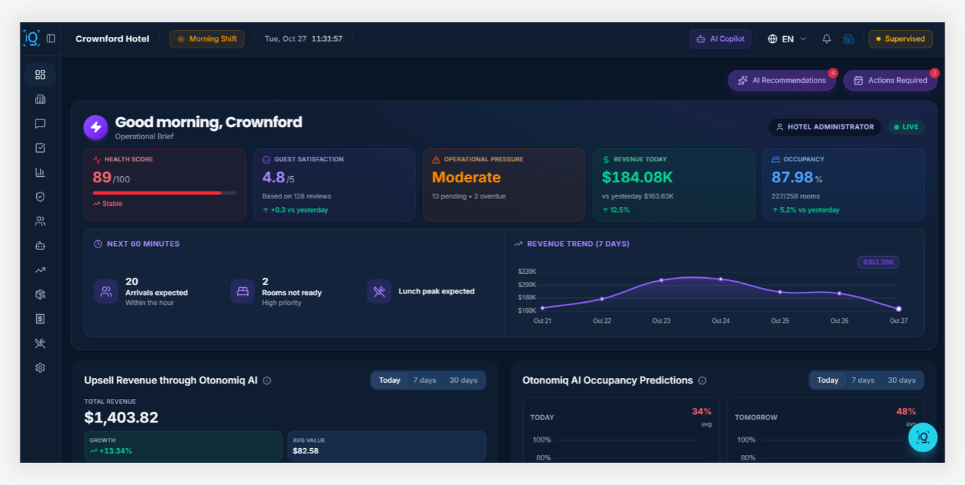
OtonomiQ is an Agentic Operating System designed to coordinate business operations through AI agents, connected systems and automated workflows.
For hospitality businesses, this approach can support workflows involving guest communication, request handling, staff notifications, task coordination and operational visibility, depending on the capabilities configured for each deployment.
For example, a guest request can be interpreted, routed to the appropriate department, tracked through a defined workflow and escalated when a response or action is overdue. Employees remain responsible for physical service delivery and decisions that require their judgment.
Hotels evaluating this approach can also read how AI can support hotel employees through coordinated workflows to understand the role of human oversight in hotel automation.
The appropriate implementation depends on the hotel's existing systems, integration requirements, operational priorities and approval policies. Each proposed workflow should be validated before it is introduced into live hotel operations.
Frequently Asked Questions
It is an AI-powered operational layer that can interpret requests, make decisions within defined rules, coordinate connected systems and execute permitted multi-step workflows. It can also track task status and escalate situations that require human intervention.
Common opportunities include guest communication, reservations, check-in coordination, housekeeping, maintenance, guest requests, room service, revenue-management support, staff task coordination and daily reporting.
Traditional automation generally follows predefined triggers and rules. Agentic AI can interpret context and coordinate multiple steps toward a defined outcome, subject to its permissions, available information and configured safeguards.
Potentially, yes. Compatibility depends on the PMS, available APIs or other integration methods, data access and the actions the hotel authorizes. Integration should be verified before implementation.
AI can support guest communication through WhatsApp when the appropriate integration and permissions are available. Depending on the workflow, it can answer approved questions, route requests to staff and communicate confirmed updates.
Yes, where the required systems and workflows are connected. It can help create tasks, notify employees, monitor progress and escalate delays. Staff should confirm physical work and room readiness.
Yes, appropriate oversight is important. Routine, low-risk actions may be automated within defined boundaries, while safety incidents, sensitive complaints, payment issues and exceptional decisions may require human approval.
Start by identifying a repetitive workflow that consumes staff time or creates frequent delays. Review its existing process, data sources, integrations and approval requirements. Pilot the workflow, measure performance and expand gradually based on verified results.
Start with the Right Hotel Workflows
Hotel process automation works best when it addresses a specific operational problem. Guest communication, room readiness and task coordination are practical starting points because they often involve repeated requests and handoffs between departments.
An Agentic AI Operating System can help connect these activities, track progress and make information more accessible to the people responsible for hotel operations. The results depend on implementation quality, system compatibility and clear operational controls.
OtonomiQ helps businesses explore coordinated AI workflows that connect requests, systems and teams within a defined operating model.
See How Agentic AI Can Support Your Hotel Operations.
